

Ayrton Senna’s Return to Formula 1: A Test of Speed and Resolve
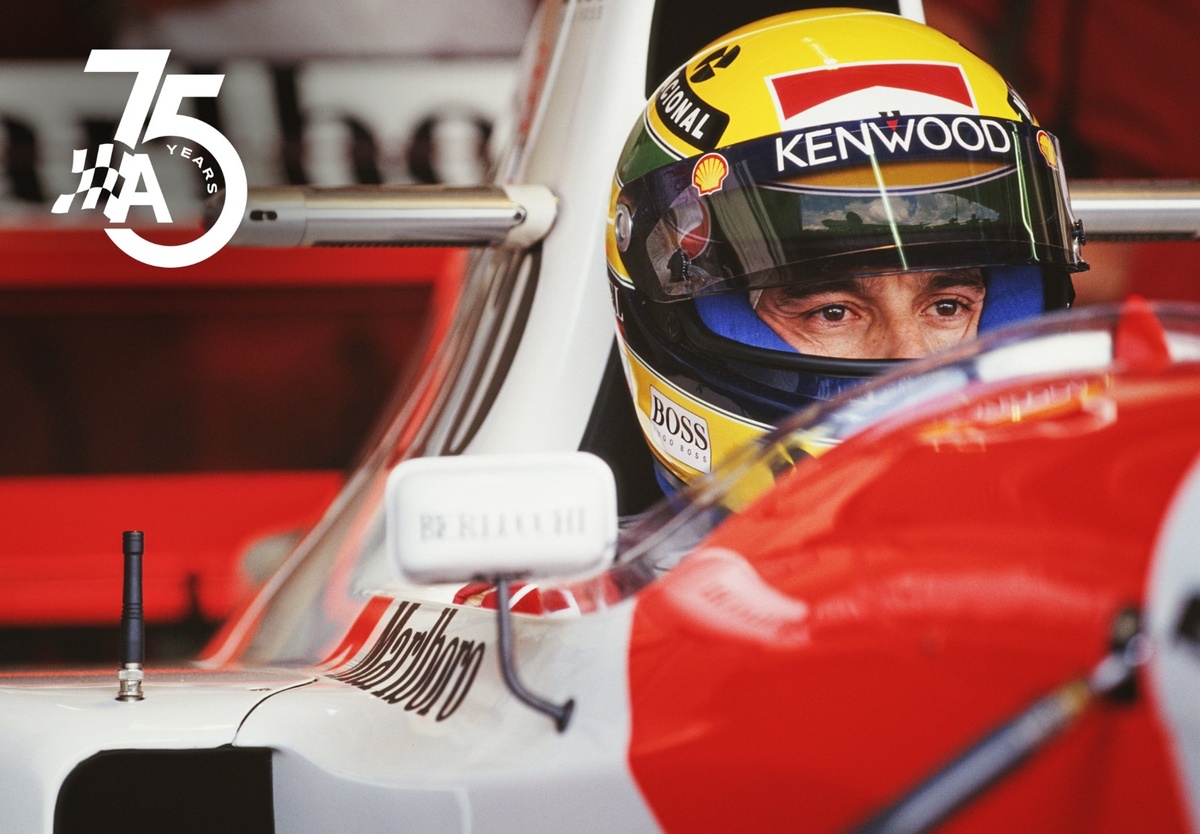
The air was just above freezing, and a small group of McLaren team members gathered around the timing desk on the pitwall shortly before lunch. Their attention was drawn to the car as it zoomed past, each time prompting the Italian engineer Giorgio Ascanelli to look up with wide eyes and a grin. He would then instruct the pit signaller to update the figures on the board. This moment captured the essence of Ayrton Senna’s return to Formula 1.
Senna had not driven an F1 car for three months, yet he set the fastest time of the winter. He spent the entire day reacclimating to the speed, even spinning a few times as he explored the new car’s limits. By lunchtime on Thursday, all doubts about the competitiveness of the new McLaren-Ford MP4/8 were dispelled as Senna pushed the car to its limits, recording times of 1m21.2s, 1m21.0s, 1m20.4s, and 1m20.3s. It was a display of consistent speed that left everyone in awe.
To put Senna’s achievement into perspective, Damon Hill had set Williams’s fastest time of the winter at 1m21.0s the day before, while McLaren’s Michael Andretti and Mika Hakkinen managed 1m21.5s and 1m21.7s respectively after two weeks of testing the all-new package. Towards the end of the day, Andretti improved to 1m21.1s as Senna delivered another astonishing sequence: 1m21.0s, 1m20.5s, and 1m20.2s.
McLaren had endured a difficult winter, with uncertainty over engine suppliers and drivers affecting the morale of a dedicated crew. However, by the end of the test, they rediscovered their faith in the team and the car. As they packed away the equipment, they pondered whether Senna would join them for the first race at Kyalami.
Senna appeared relaxed but tired after the test, acknowledging the hard two days but expressing satisfaction. “The car is of course pretty fast,” he said with his usual understatement. He reflected on the challenges of Silverstone, a circuit known for its difficulty in setup. “My goal coming here was really a second step on a positive path towards racing this year,” he explained.
He mentioned the previous meeting with Philip Morris in Lausanne, Switzerland, which had been constructive. “Step three we will make the decision,” he added. Senna also spoke about the challenges of driving at high speeds, noting the incredible G-forces and the need for instinctive reactions. “It’s very difficult to drive at that speed because there are incredible G-forces going through your body,” he said.
Despite his weariness, Senna’s eyes sparkled with excitement. He was clearly impressed by the speed of the new McLaren and was contemplating how the car might develop over the coming year. However, he remained cautious, aware that if he wanted to race the car this year, there was still some hard negotiating to do with Ron Dennis and sponsor Marlboro.
“It’s a dangerous situation to be in,” he reflected. “Particularly when you have been away for three months without driving. I am not up to speed on my reflexes, so I have to control myself.” Senna noted the progress made between the first and second days, both for himself and the car. “But you know, you lose a second a lap if you just think about something.”
He emphasized the difficulty of tuning the mind and body, explaining that decisions often came too late. “You think about something and it’s already too late. So you go by instinct, you guess what is going to happen so you can act as it happens.”
Senna believed the performance was there, though reliability issues remained. “There are still difficulties with reliability. With all the electronics there are small things which have to be understood before they can be adjusted and modified. There is still a lot of development to do.”
Although he refused to admit it, Senna clearly realized he wanted to race this year. However, money was always a sticking point in negotiations between him and McLaren. He had been with the team for five consecutive seasons, winning three world championships, and each time a contract needed renewing, he added a few million to the bill.
The atmosphere in the McLaren garage was reminiscent of the good old days, when Senna and McLaren were at their mightiest. “You know when you’re going quick,” he said thoughtfully. “Almost corner by corner you know, and then the final lap time on the pitboard is just a consequence.”
After many seasons with multi-cylinder Honda engines, Senna found the new Ford HB V8 engine different. “The V8 is totally different engine. It has a lot more power at the bottom and middle of the rev range, but less at the top end. It also goes around corners differently. The throttle control is totally different and it has taken a lot of effort for me to learn the new characteristics of the engine.”
Senna’s passion for racing was evident. “The feeling I get from racing is something I can’t explain. It is not something I necessarily understand but I have experienced it, felt it and it’s incredible.” He spoke about the journey back to racing, mentioning the role of a friend who persuaded him to come back.
“I’ve been in Europe for 10 days and it has taken that long to meet with people and make all this happen. We will just have to wait and see,” he said. On Monday, the news spread that Senna would race for McLaren in 1993 – the Brazilian was back.


