

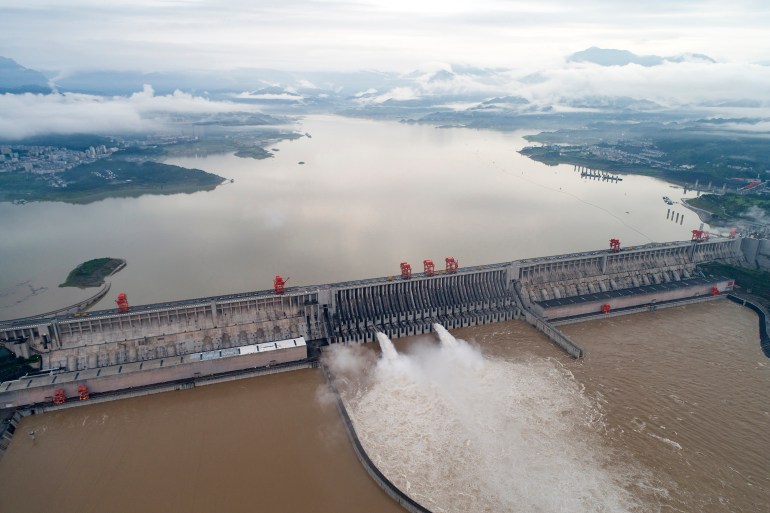
The location in the remote and sparsely populated Tibetan borderlands has the potential to cause environmental and political ructions
China has officially broken ground on what is set to become the world’s largest hydropower dam on the Tibetan Plateau.
The dam is being built on the Yarlung Tsangpo in Medog – a remote yet geopolitically significant county close to the disputed border with India.
As well as becoming a major energy source, the dam is a key element in Beijing’s plans to develop the region and strengthen its border security.
Do you have questions about the biggest topics and trends from around the world? Get the answers with SCMP Knowledge, our new platform of curated content with explainers, FAQs, analyses and infographics brought to you by our award-winning team.
However, it could also aggravate tensions with India as a result of a long-running border dispute and concerns about the impact on the environment and water security.
What is the location?
Medog, also known as Motuo in Chinese, is a border county in the southeast of the Tibet autonomous region, which lies in the foothills of the Himalayas.
The dam will harness the immense hydropower from the Great Bend, a steep canyon where the Yarlung Tsangpo makes a horseshoe turn, then drops about 2,000 metres (6,500 feet) over a 50km (30-mile) stretch.
As the river travels into India, it becomes the Brahmaputra river, which then flows through Bangladesh into the sea.
Medog’s mountainous setting meant it was once cut off from the rest of Tibet for much of the year, but in recent years the authorities have been building roads, tunnels and railways to better connect it to the outside world.
Its setting and ecological diversity have also seen it become a popular tourist destination in recent years.
Why is the site significant?
The project has heightened concerns about the environmental impact locally and downriver in India and Bangladesh, where the Brahmaputra is a vital water source for millions of people.
Some Indian politicians have expressed concern that Beijing could use the dam as a “water bomb” that could cause flooding or cut supplies, while the environmental concerns include the risk of landslides and damage to fragile ecosystems.
China has insisted it will not use the dam to benefit at the “expense of its neighbours” and has said it will carry out rigorous geological surveys and environmental monitoring.
A further concern for New Delhi is its location just north of the Line of Actual Control (LAC), the de facto dividing line between Chinese and Indian-controlled territory.
Beijing claims the Indian-controlled state of Arunachal Pradesh that lies to the south as part of south Tibet.
The Chinese authorities have already been engaged on a series of infrastructure projects to boost connectivity and have reportedly been constructing and expanding hundreds of villages in a region where India has traditionally held the military advantage.
Lin Minwang, deputy director of Fudan University’s Centre for South Asian Studies, said the dam could bring in over a further hundred thousand people while more infrastructure projects would help “improve the [area’s] geopolitical status”.
However, Zha Daojiong, a professor at the School of International Studies at Peking University, said “observers will need to wait and see if the locality does become a magnet for migrants” given China’s declining birth rates.
What do we know about China’s plans for the dam?
A plan published by the authorities in Medog for 2021 to 2035 details schemes to develop a clean energy cluster and support the construction of a hydropower base.
The genesis of the project stretches back decades, with the Yarlung Tsangpo being designated a “long-term strategic reserve project” in 2003.
Field surveys were launched near the Great Bend in 2014 before the project was included in the most recent five-year plan.
Beijing authorised construction in December 2024 with work finally beginning this month.
The megaproject will have a cost of around 1.2 trillion yuan (US$167 billion), according to state news agency Xinhua, and once complete could produce up to 300 billion kilowatt-hours of electricity each year, three times the output of the Three Gorges Dam on the Yangtze.
More Articles from SCMP
China unveils the largest crystal for high-powered laser weapons
Hong Kong urged to make itself ‘truly the world’s green financial centre’
US’ ‘anti-Beijing trade plan’, little-known China oversupply issue: SCMP daily highlights
New fencing star Ryan Choi gives Hong Kong a victory to savour
This article originally appeared on the South China Morning Post (www.scmp.com), the leading news media reporting on China and Asia.
Copyright (c) 2025. South China Morning Post Publishers Ltd. All rights reserved.


