

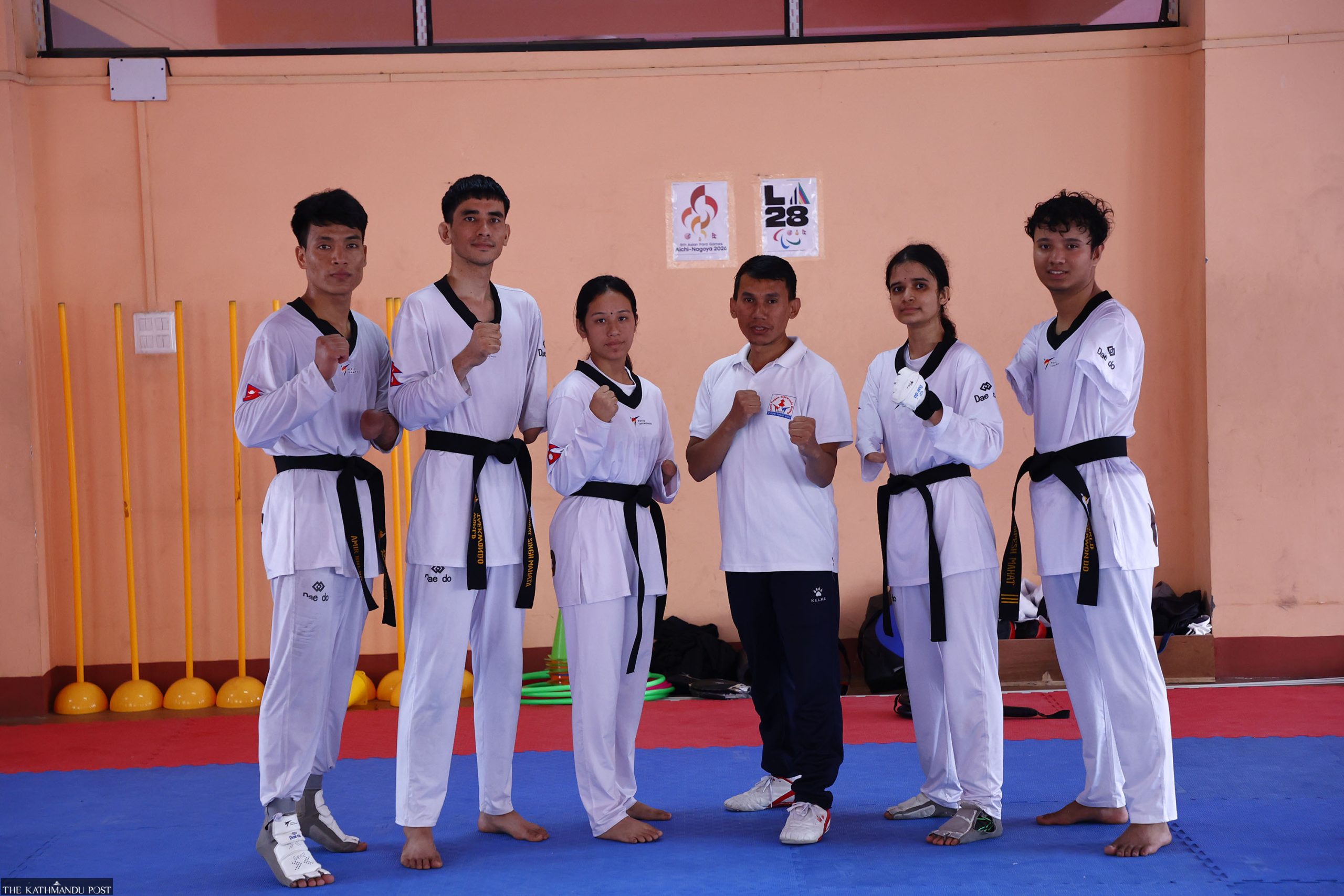
Kathmandu, July 27 — Each day, except for Saturdays, Kabiraj Negi Lama enters a small taekwondo gym located within the Nepal Taekwondo Association building in Satdobato, Lalitpur. The sun is just beginning to rise, yet the room is already filled with the sounds of strong, intimidating kicks striking practice pads and the loud “aah!” of athletes striving to reach their maximum potential.
They are para-taekwondo athletes—five of them—all striving for the same goal: winning medals for their nation. And Lama is their coach—volunteer, unknown, yet still committed.
Within a year, Lama assisted Palesha Goverdhan in securing Nepal’s first-ever medal at the world’s largest multi-sport event—a bronze in the K44 -57kg category at the 2024 Paris Paralympics.
It was a time filled with historical significance. Banners were raised. Addresses were delivered. Commitments flowed freely.
Among them was a straightforward position: Lama would receive an official mentoring role.
However, almost a year later, Lama, who has helped Nepal win 11 official international medals—three gold, two silver, and six bronze—has still not been appointed.
During the day, Lama is employed by the All Nepal Football Association (ANFA). Each morning, he dedicates his time to coaching the upcoming para-fighters—Bharat Singh Mahata, Amir Bhlon, Dipesh Mahat, Kamana Prasai, and Renu Tamang—who are currently getting ready for the 10th Asia Para Taekwondo Championships, a G4 level competition, taking place in Kuching, Malaysia.
Goverdhan (-57kg), Mahata (-58kg), Bhlon (-63kg), Prasai (-47kg), and Tamang (-47kg) are set to travel to the competition on July 29, with their matches scheduled for August 1. “Mahat, who is missing both hands, won’t be joining us since there weren’t enough participants in his category,” Lama mentioned. “Goverdhan will arrive in Kuala Lumpur directly from China, where she is studying for her bachelor’s degree in architecture engineering. We will then travel to Kuching together.”
The Kathmandu District Taekwondo Association and the Nepal Chamber of Commerce (NCC) said goodbye to the team during a gathering on Saturday.
It’s a significant competition,” Lama remarked. “A strong performance here might create opportunities for our athletes leading up to the 2028 Los Angeles Games.
A trophy, but no employment
Lama’s personal Olympic aspiration had come to an end years prior—he was once a talented taekwondo competitor, but frequently struggled against opponents who were taller.
I wasn’t tall enough,” he said. “So, I considered becoming a referee, just to be involved in the Olympics.
That route also came to an end. However, during his referee training, Lama discovered something that changed his perspective: the Olympics and Paralympics held equal importance, operating under the same systems and principles. By accessing the official social media accounts of Paris 2024, LA 2028, and Brisbane 2032, he displays their profile images. “The symbols of the Olympics and Paralympics are placed next to each other. These identical logos speak volumes,” Lama stated.
My aspiration was to compete in the Olympics. I wasn’t able to achieve it as an athlete, but I joined a team that won a medal. Now, others are striving for the same goal. I can’t abandon them.
Dreams for Rs 100 per day
Lama’s five athletes are committed but face financial difficulties.
They receive only Rs100 per day from the association for training, which barely covers transportation expenses. A separate daily allowance of Rs500 under the government’s ‘Mission 26’ program, designed to help win a gold medal and achieve double-digit medals at the 2026 Asian Games, was recently discontinued at the end of the fiscal year 2024-25, due to financial limitations. Lama was one of those who benefited from it.
In martial arts, where a practitioner requires proper nutrition and diet to remain fit while focusing on injury prevention, a few hundred rupees is insignificant. Yet, the athletes continue to appear.
Consider Bharat Singh Mahata. He comes from a village close to Lipulekh, one of the most isolated border areas in Nepal. Born without his left hand below the elbow, Mahata initially played volleyball but had to quit because of limited inclusive options.
He arrived in Kathmandu in 2015 looking for some para-sports to participate in.
I searched for one-handed cricket on YouTube and even gave wheelchair cricket a try in Kathmandu,” he remembered. “But nothing went well.
Downcast, he made his way back to his village, a trip that still requires more than two days, involving many hours of walking from the last bus stop.
In 2023, he returned to the Capital upon learning about para-taekwondo and encountered Lama.
Only two years into his career, he is already regarded as one of Nepal’s most talented athletes.
I simply desired a place where my abilities would be acknowledged,” he stated. “Individuals like us don’t receive appropriate employment opportunities. We aren’t viewed with the same perspective. Having victories in significant competitions, I aim to alter how we are perceived.
Currently 27, Mahata is married, has a young son, and provides support for three sisters. He raises cows to sell milk and assists in managing the home.
Rs100 might seem insignificant, but it’s what kept me moving forward,” he said. “Whether taking a bus or purchasing a bottle of water, I think about it a hundred times before spending money. I know I receive almost nothing from the government, but at least that amount has helped me keep going.
Mahata also comes back in the evenings from Kirtipur to train with able-bodied taekwondo practitioners, striving to achieve a higher level of performance.
Gold, not survival
Within the training facility, two A4-sized sheets are displayed on the wall: one features the LA28 logo, while the other shows the 2026 Asian Games symbol. Mahata affixed them himself.
Paris was challenging,” he mentioned regarding the Paralympics, where he didn’t advance to win a medal. “However, the Asian Games in Japan and the Paralympics in Los Angeles—those will be different. This time, I’m not training for bronze or silver. My goal is gold.
The desire has gained momentum. Amir Bhlon, who started the sport on October 24, 2021, a day he distinctly recalls, kicks off his morning routine by jogging around the Satdobato sports complex seven times—his pre-exercise tradition.
I’ll continue to improve more and more,” he stated. “I aim to secure medals on the most prominent stages.
Every athlete has a comparable experience: minimal financial assistance, unstable employment, and increasing personal obligations.
There are no good job opportunities for individuals with disabilities in this country,” stated Bhlon. “Previously, I worked for a platform that contacted clients, reminding them of payment deadlines. However, I left to concentrate on training. As for how I am managing now, even I am unsure.
However, each morning, they come back to that hall, their kicks more precise, their voices more energetic, and their eyes still fixed on a better tomorrow.
Will the medal matter?
Lama thinks the Paris bronze had a significant impact. Since Goverdhan’s victory, there has been a noticeable increase in interest, with more people with disabilities engaging in para-sports, inquiring about possibilities, and appearing at events.
Thanks to the facility and fundamental training gear offered by the association,” Lama added, “we are still able to practice our kicks and continue striving toward goals that appear unattainable.
However, it is unclear if this interest is supported by institutional resources.
If we don’t take action immediately, we’ll miss our chance,” Lama stated. “This shouldn’t be a single event. A structured approach is necessary.


