

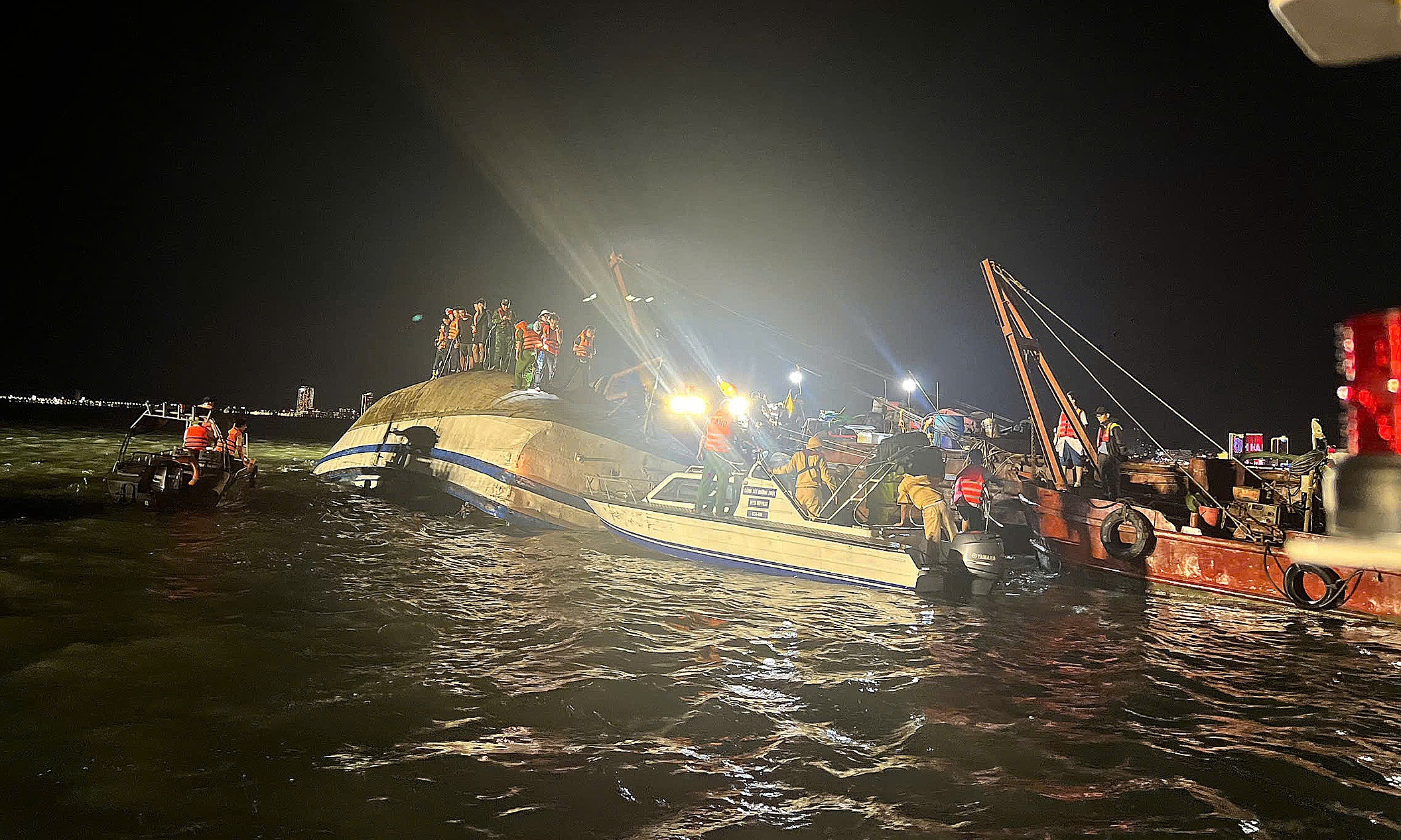
The most severe boat accident in Ha Long Bay in recent years could be more than just a disaster, serving as a cautionary signal regarding underlying dangers within Vietnam’s maritime laws.
The Vinh Xanh 58 had 49 individuals on board when it capsized near Dau Go Cave on July 19. The vessel lost GPS connection shortly after. Just 10 passengers made it through. One person is still unaccounted for.
Constructed in 2015, the Vinh Xanh 58 measured 24 meters in length, was permitted to transport 48 passengers, and was approved for operation in inland waters where wave heights reach up to 2 meters. The vessel surpassed national safety standards, boasting a stability coefficient of 2.3, which is more than twice the required minimum, according to Bui Hong Minh, vice director of the Quang Ninh Department of Construction, on July 20.
However, critics contend that the certification might not accurately represent the actual dangers associated with working in Vietnam’s popular coastal tourist areas.
Standards fall short
If a boat meets all the requirements yet capsizes within moments, it indicates there’s an issue, stated maritime safety expert Do Binh Duong. He thinks existing rules, created for more tranquil inland waters, are inadequate in the unpredictable conditions found in coastal areas such as Ha Long Bay.
Duong, an expert from SAMASER Holdings, stated that passenger boats must adhere to the highest safety standards among all types of vessels, particularly those transporting tourists. This includes not only a stable hull design suitable for turbulent weather, but also dependable safety equipment and explicit emergency procedures. Without these three elements, he cautioned, no boat can be adequately prepared for unexpected situations.
Although Vinh Xanh 58 met the minimum required standards, its unexpected sinking has created serious concerns. Duong stated that using inland waterway regulations for Ha Long Bay, which is a coastal marine area, is excessively old-fashioned.
Even small yachts adhere to SB-class regulations when sailing at sea,” he said. “So why are tourist boats in one of Vietnam’s most dangerous marine zones treated as if they were river ferries?
He urged the boats in Ha Long Bay to follow SB-class guidelines, designed for more challenging ocean conditions, such as waves reaching 2.5 meters high.
In reply, Vu Anh, head of the Inland Vessel Department at the Vietnam Register, referred to the legislation that defines inland waters as any navigable body reachable by inland vessels, such as rivers, canals, lagoons, bays, and coastal areas close to shore.
According to national technical regulations, Ha Long Bay and Bai Tu Long Bay are classified as SII areas, where wave heights can reach up to 1.2 meters. Routes linking Ha Long Bay to Cat Ba Island and Hai Phong–Cat Ba are categorized as SI, with maximum wave heights of 2 meters. The Vinh Xanh 58 was constructed according to VR-SI standards, which are more stringent than VR-SII, allowing it to function both inside Ha Long Bay and on open-sea routes to Cat Ba.
In response to demands for tighter regulations, Vu Anh mentioned that Vietnam’s ship standards were created in partnership with universities and research institutions, and aligned with international standards from nations such as Japan, China, and Russia. The most recent update, issued in 2025, aims to conform to global best practices. Regarding Ha Long Bay, he noted that both wave height and wind intensity were considered in the calculations.
To guarantee safety, Vu Anh stated, boats need to follow a detailed procedure: starting with design authorization and monitoring during construction, followed by certification and regular checks. Each boat’s blueprints must be examined and approved prior to its construction. After completion, it has to successfully undergo a technical and environmental safety assessment to obtain certification.
“Every year, ships undergo re-examination. They must also have active permits for the vessel and its crew, along with daily port authorization prior to departure,” he added.
Hoang Giang, former Head of Maritime Safety at the Hai Phong Port Authority, described the unexpected overturning of the Vinh Xanh 58 as “highly unusual,” pointing out that a vessel capsizing within seconds is a significant warning sign.
Following such an event, he stated, investigators need to review several elements: design standards, number of passengers, weather circumstances, and the way the boat was managed. VR-SI boats, he mentioned, are generally smaller and intended for tranquil or coastal waters, not turbulent, open bays.
If waves go beyond a boat’s design capabilities, it can rapidly lose balance. A high center of gravity or inadequate balancing mechanisms increases its risk of capsizing due to powerful side waves. He mentioned that authorities should examine if the Vinh Xanh 58 had been altered, overloaded, or suffered structural damage.
A maritime specialist mentioned that VR-SI ships are designed to handle wave heights of up to 2 meters and must stay within 12 nautical miles of the coast. In the case of Ha Long Bay’s busy tourist routes, he stated that vessels should adhere to VR-SB standards, which represent the highest classification for inland watercraft.
SB-class hulls are designed to withstand waves as high as 2.5 meters. This requires the use of stronger materials, a more robust structure, and improved stability in harsh environments. Important safety elements, such as the height of the freeboard, resistance to wind pressure, and the positioning of ballast tanks, must all be carefully planned and examined.
Regarding onboard technology, SB-class vessels are mandated to be equipped with sophisticated navigation and safety systems. This includes radar, AIS (Automatic Identification System), maritime alerts, and portable radios. Importantly, they are required to have distress beacons that activate automatically when the boat is in danger, transmitting emergency signals through satellite to rescue organizations.
Stronger safeguards needed
In reply to the safety worries, Vu Anh emphasized that no ship, irrespective of its design, can be completely protected from unexpected, severe weather conditions such as sudden storms. That’s why, he mentioned, safety needs to be maintained through operations, not only through technical measures.
This involves prohibiting voyages in dangerous weather conditions, providing real-time notifications to ships that are already out at sea, educating passengers on evacuation procedures during emergencies, and making sure that captains seek immediate refuge near islands when storms approach.
Certain maritime specialists are currently advocating for a specialized 24/7 search and rescue unit for Ha Long Bay, comparable to coast guard organizations in different nations. This group would track ship signals continuously and react immediately to emergency calls, enhancing response times and preserving lives.


