


Thailand and Cambodia fought for the fourth day on Sunday, even though both sides claimed they were prepared to talk about a truce following a late-night effort by U.S. President Donald Trump.
The neighbors, who attract millions of international visitors each year, are currently experiencing their most violent conflict in recent times due to the contested border, resulting in at least 33 confirmed deaths and over 200,000 people forced to leave their homes.
Both expressed their readiness to initiate discussions aimed at ending the conflict, following Trump’s late Saturday conversation with the two prime ministers, during which he stated they had agreed to meet and “quickly resolve” a ceasefire.
However, new artillery fighting broke out on Sunday morning near two historically disputed ancient temples in the border area between northern Cambodia and northeastern Thailand, which has been the main site of the conflict.
A spokesperson from the Cambodian defense ministry, Maly Socheata, stated that Thai forces started attacking regions near the temples at 4:50 a.m.
The constant pounding of artillery shook the windows in the Cambodian town of Samraong, located approximately 20 kilometers (12 miles) from the combat zone,AFP journalists said.
Lieutenant Colonel Ritcha Suksuwanon, a deputy spokesperson for the Thai Army, stated that Cambodian forces started shelling with artillery around 4:00 a.m., as both sides fought for dominance over key locations.
 |
|
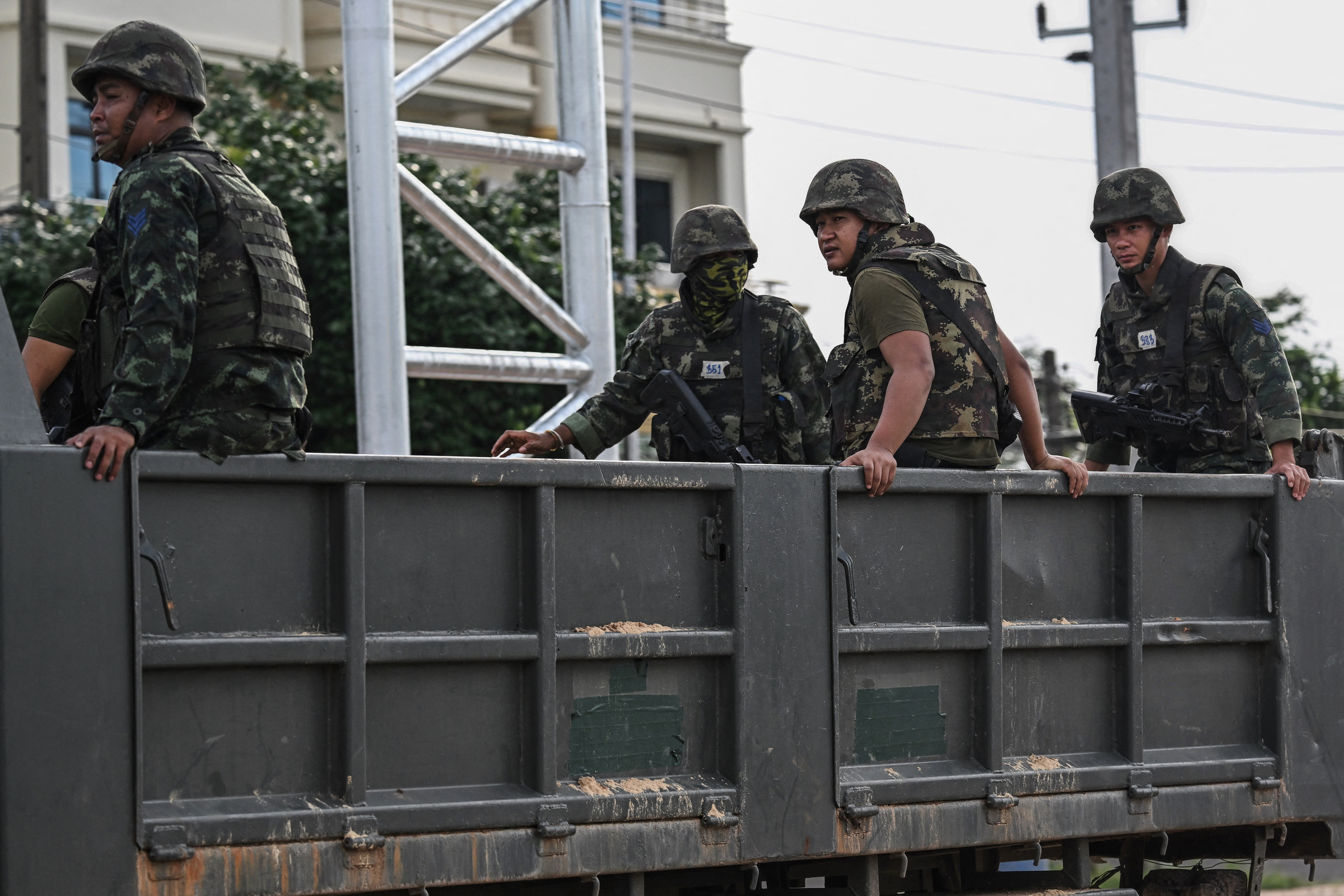
Soldiers from the Royal Thai Army were carried on the back of a military truck in Si Sa Ket, a border province in Thailand, on July 26, 2025. On the same day, Thailand and Cambodia continued exchanging intense artillery fire for the third consecutive day, as a border dispute that resulted in at least 33 fatalities and forced over 150,000 people to leave their homes spread along the border. Photo by AFP. |
Ceasefire calls
Cambodian Prime Minister Hun Manet stated on Sunday that his nation “supports the suggestion for an immediate and complete halt to hostilities between the two military groups.”
He mentioned that his Foreign Minister, Prak Sokhonn, will meet with U.S. Secretary of State Marco Rubio to align efforts with the Thais, yet cautioned Bangkok against breaking any agreement.
Previously, following Trump’s call, Thailand’s acting Prime Minister Phumtham Wechayachai stated that he had agreed in principle to initiate a ceasefire and begin negotiations “as soon as possible”.
However, he cautioned that Cambodia needed to demonstrate “genuine intent” in achieving peace.
A prolonged conflict over the border flared up this week as aircraft, tanks, and infantry engaged in combat within the rural border area, characterized by a range of hills encircled by dense jungle and farmland where residents cultivate rubber and rice.
Thailand reports that seven of its soldiers and 13 civilians have lost their lives, while Cambodia has verified eight civilian fatalities and five military personnel.
Over 138,000 individuals have been displaced from Thailand’s border areas due to the conflict, while 80,000 have been compelled to leave their residences in Cambodia.
Following an emergency meeting of the United Nations Security Council on Friday in New York, Cambodia’s UN representative, Chhea Keo, stated that his nation is seeking “an immediate halt to hostilities” and a peaceful settlement of the conflict.
UN leader Antonio Guterres called on both parties on Saturday to “quickly reach a ceasefire” and engage in discussions to discover a long-term resolution.
“The UN Secretary-General expresses condemnation for the tragic and avoidable loss of lives, injuries to civilians, and the destruction of homes and infrastructure on both sides,” said Farhan Haq, the deputy spokesperson, in a statement.
Each side has accused the other of being the initial aggressor.
Cambodia has also alleged that Thai forces have employed cluster bombs, while Thailand has accused Cambodia of attacking civilian facilities, including a hospital that was struck by shells.
The conflict represents a significant intensification of an ongoing disagreement between the neighboring countries regarding their 800-kilometer shared border, with several kilometers being disputed.


