

Growing Concerns Over Proposed Revisions to the Commercial Act
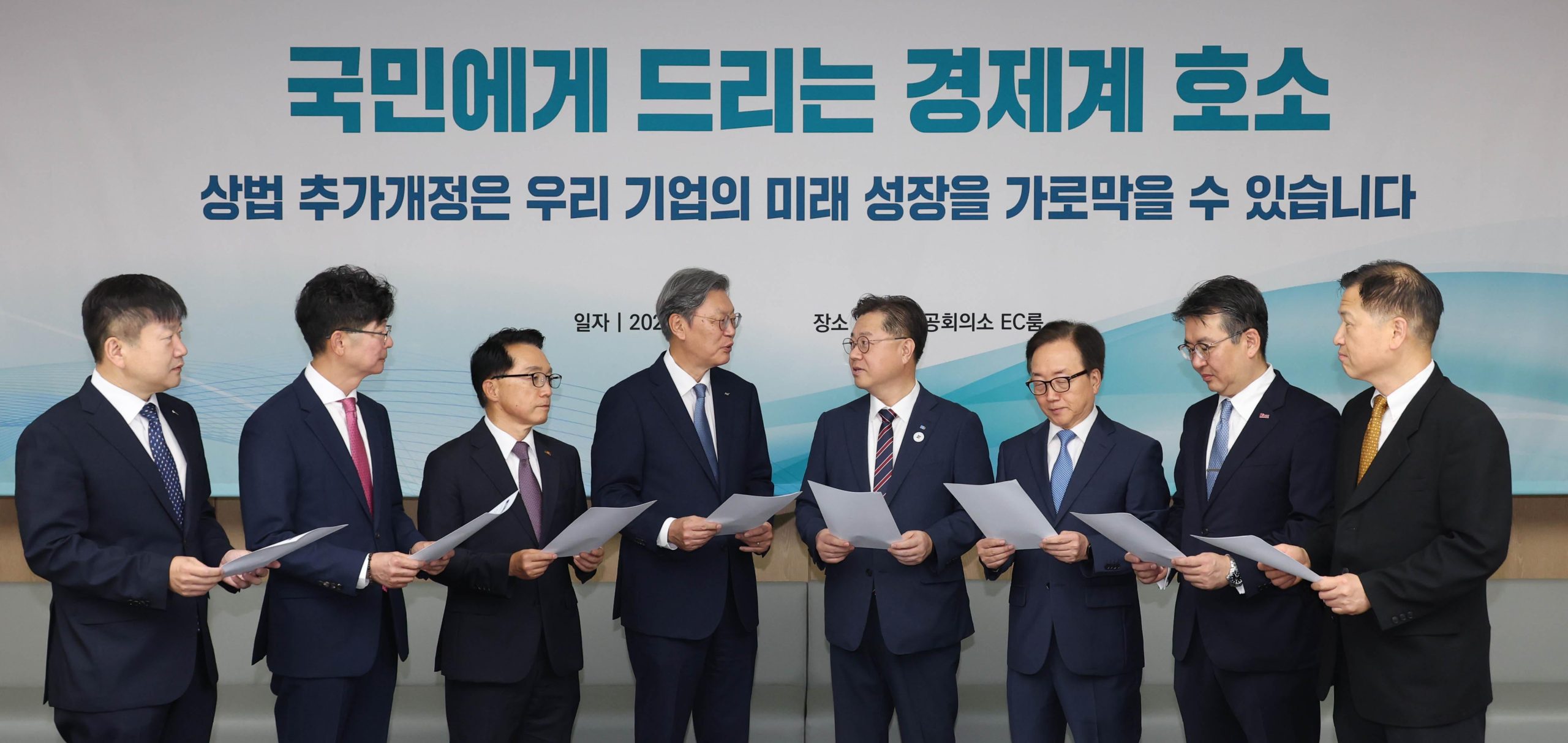
South Korea’s major business organizations have raised significant concerns about recent legislative changes aimed at revising the Commercial Act. These proposed amendments, which are seen as potentially detrimental to corporate operations, have sparked a joint public appeal from eight leading economic groups. The groups expressed their apprehension that the government and ruling party’s push for further revisions could lead to far-reaching negative consequences.
The joint statement, issued by vice chairpersons of these organizations, highlighted the potential impact of the reforms on managerial discretion, restructuring efforts in key industries, and the development of new growth drivers. They urged the public to support companies in focusing on overcoming the current economic crisis. This direct appeal comes after the National Assembly passed the first-round amendment to the Commercial Act, which expanded the fiduciary duties of corporate board members to include all shareholders.
Following this, the government and ruling party introduced a second set of revisions, mandating cumulative voting and increasing the number of audit committee members elected separately from the board. Business leaders criticized the pace of these changes as rushed and lacking proper consultation.
Impact on Corporate Governance
One industry representative acknowledged the goal of strengthening protections for minority shareholders but emphasized the need for countermeasures to minimize potential side effects. Without such safeguards, there is growing alarm that South Korea’s major companies could lose control to foreign activist funds, be pushed toward unsustainable dividend payouts, and forced to sell off critical assets. This could weaken their investment capacity and jeopardize the national economy.
Amid a flurry of labor and corporate legislative initiatives under the new administration, concerns have intensified. These include proposed revisions to Articles 2 and 3 of the Trade Union and Labor Relations Adjustment Act, known as the “Yellow Envelope Law,” as well as potential increases to the legal retirement age and a proposed reduction of the standard workweek to 4.5 days.
Specific Implications for Listed Companies
The second round of Commercial Act revisions would apply to listed companies with assets exceeding 2 trillion won ($1.4 billion). Under the proposal, these companies would be required to adopt cumulative voting systems and increase the number of audit committee members elected separately at shareholder meetings from one to two. The initial reform capped the voting rights of major shareholders and their related parties at a combined 3%, a provision that business leaders argue exposes domestic firms to hostile takeovers by foreign activist investors.
A mid-sized company listed on the KOSDAQ market specializing in logistics software conducted internal simulations showing the new rules could directly threaten its corporate governance. Previously, the company’s largest shareholder and related parties held a combined 17% of voting rights, significantly outweighing the 3% held by a U.S.-based hedge fund. However, under the revised cap, both sides would be limited to 3%, giving minority shareholders effective control over audit committee elections.
Potential Scenarios and Industry Responses
If the second set of revisions is passed, it’s not difficult to imagine a scenario where hedge funds align with minority shareholders to secure a majority on the audit committee, leading to a swift takeover of management. A company official warned that such a situation could undermine corporate stability.
The eight business groups also noted that South Korea ranks third globally—after the United States and Japan—in the number of companies targeted by foreign activist funds. They argued that pushing forward with additional Commercial Act amendments could weaken corporate fundamentals, limit long-term growth potential, and ultimately erode shareholder value.
Surveys and Meetings Highlight Concerns
A survey conducted by the Korea Chamber of Commerce & Industry among 300 listed companies revealed that 77% of respondents believed the second round of revisions would negatively impact corporate growth, while 74% felt the changes could pose a direct threat to management control. Business leaders emphasized the need for regulatory safeguards before any further legislative action is taken.
These concerns were also raised during separate meetings between Minister of Employment and Labor Kim Young-hoon and leading business figures, including Korea Chamber of Commerce & Industry Chairman Chey Tae-won, Korea Enterprises Federation Chairman Sohn Kyung-shik, and Korea Federation of SMEs Chairman Kim Ki-moon. During these discussions, business leaders conveyed their concerns over the government’s labor policy direction, including the Yellow Envelope Law, proposals to raise the retirement age, and the move toward a shortened workweek.


