

A Historic Peace Agreement Between Armenia and Azerbaijan
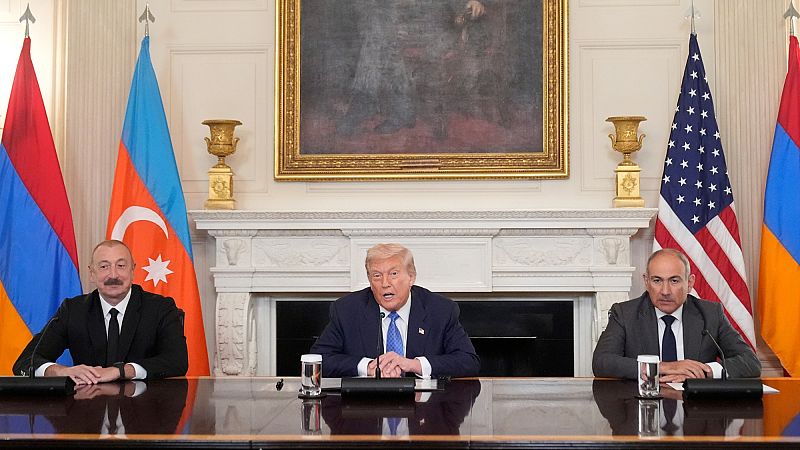
In a significant development, the leaders of Armenia and Azerbaijan, Nikol Pashinyan and Ilham Aliyev, signed a peace agreement in Washington, D.C., on Friday. The ceremony took place in the presence of former U.S. President Donald Trump, marking a pivotal moment after nearly four decades of conflict over the Karabakh region.
“We are today establishing peace in the South Caucasus,” said Azerbaijani President Ilham Aliyev. “Today we are writing a great new history.” Armenian Prime Minister Nikol Pashinyan echoed these sentiments, stating that the agreement represents “opening a chapter of peace” and laying the foundation for a better future.
Trump emphasized the importance of the agreement during a joint press conference with the two leaders, highlighting that the countries have committed to ending all fighting forever. He noted that while previous efforts by the European Union and Russia failed to bring about a resolution, this accord has finally succeeded in making peace.
The Role of the Trump Route
A key component of the agreement is the establishment of a major transit corridor named the Trump Route for International Peace and Prosperity. This route will connect mainland Azerbaijan with its Nakhchivan region, which borders Turkey via Armenian territory. The White House described the corridor as allowing unimpeded connectivity between the two countries while respecting Armenia’s sovereignty and territorial integrity.
For Azerbaijan, the corridor offers a direct land connection to Nakhchivan, strengthening ties with Turkey and consolidating post-war gains through infrastructure diplomacy. It also enhances Azerbaijan’s position as a crucial transport and logistics hub globally. Initially, Baku had preferred to manage the corridor independently without external involvement, but the agreement now includes U.S. support.
For Armenia, the route presents an opportunity to integrate into broader trade networks, diversify its economy, and attract foreign investment. Geopolitically, it helps normalize relations with neighboring countries. However, Yerevan was concerned about potential threats to Armenian sovereignty, leading to discussions about the corridor being operated under Armenian law.
Dissolving the OSCE Minsk Group
Armenia and Azerbaijan also signed a document on dissolving the OSCE Minsk Group, which was established in 1992 to facilitate the resolution of the Karabakh conflict. Pashinyan stated that if they are closing the page on the conflict, there is no need for a format dealing with its settlement. The group had been chaired by France, the U.S., and Russia.
The dissolution of the Minsk Group not only marks the end of the Karabakh conflict but also formalizes Baku and Yerevan distancing themselves from Moscow. The joint request made in Washington sends a strong signal to Moscow regarding the two countries’ commitment to finding solutions independently and redirecting their foreign policy focus toward the West.
Strained Relations with Russia
Moscow has been attempting to repair cooperation with both Baku and Yerevan, offering “mediation” and launching disinformation campaigns against Yerevan. Russian state-controlled media has criticized Pashinyan, accusing him of trading Armenian sovereignty for personal financial gains and calling him a “puppet.”
Additionally, Russia has made false allegations about a bio-weapons facility in Armenia orchestrated by the Americans. Similar claims were previously made about U.S. bio-weapons facilities in Ukraine and Georgia.
Russia’s attempts to repair ties with Baku were further strained when an Azerbaijani airliner crashed in Kazakhstan, killing 38 of 67 people aboard. Investigations revealed that the plane was shot at by Russian air defense over Grozny and rendered uncontrollable by electronic warfare.
Aliyev announced that Azerbaijan is preparing to file lawsuits in international courts against Russia regarding the crash. He drew a parallel to the Malaysian airline Boeing case, where the aircraft was shot down by Russian militants over Ukraine. Aliyev emphasized that justice must prevail, even if it takes years.
Escalations Between Azerbaijan and Russia
Last month, Azerbaijan and Russia engaged in another rare escalation. Baku detained the executive director and editor-in-chief of Russia’s state-run news agency Sputnik following Moscow’s raids of the Azeri community in Yekaterinburg. Two people died during the raid by the Russian Federal Security Service (FSB), and 50 more were detained. These incidents highlight the ongoing tensions between the two nations and underscore the complex geopolitical landscape in the South Caucasus.


